
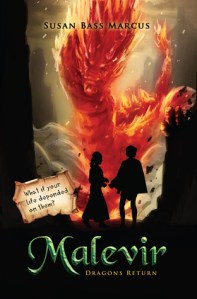
 Dear readers, tonight with me is a little sprite, from a faraway fantasy world.
He is here to tell us about the dangers that afflict his world, about the return of dragons, and about the other wonderful and wondrous creatures that inhabit it.
Tell us a little about where you grew up. What was it like there?
I am a Dragonwolder sprite called a Lobli, about 18 inches high. I see the world from the height of your knee cap. Dragonwolder is my world, a broad and varied land mass surrounded by seas. I was born in dark times, and I don’t mean at night. A destructive force, the Malevir, was burning farms and towns and killing people’s herds. I left my family of house sprites early on to apprentice with the magician giant Rocànonom who was planning to rescue Dragonwolder from the Malevir by reviving its exiled dragons.
Do you have cherished memories from your childhood?
Before I left home, my parents, sister, and I lived in the wall behind a cottage hearth in the village of Anonom. We helped clean, cook, and care for the indwellers. Secretly, of course, but they always left savory porridge and milk out at night. We all liked that very much. I remember those calm and cozy times with pleasure. I also remember my father’s saying as I parted for Rocánonom’s tower, “Someday, they’ll all be talking about you and how you made peace between the people of Dragonwolder and its long-hidden dragons.” Imagine how my two hearts leaped at the thought.
What do you do now?
What don’t I do? I am on Rocánonom’s team, helping him restore order and safety to Dragonwolder. I am small, but loyal and adventurous. You should have seen me bite into the Malevir’s shin—ah, I shiver at the thought, how the beast poisoned me the first time. Anyway, I wanted to protect my giant friend and fellow Loblin from the Malevir’s attack after the beast discovered our secret refuge under a town. Everyone thought the poison killed me, but I came back to life in the dragons’ lair. All that is in our scribe’s account, Malevir: Dragons Return. Continue reading “Sweetnettle the Lobli (of The Malevir Series, by Susan B Marcus)”







 The Protagonist Speaks
Recent Comments