Search

The Protagonist Speaks

Interviews with the characters of your favourite books

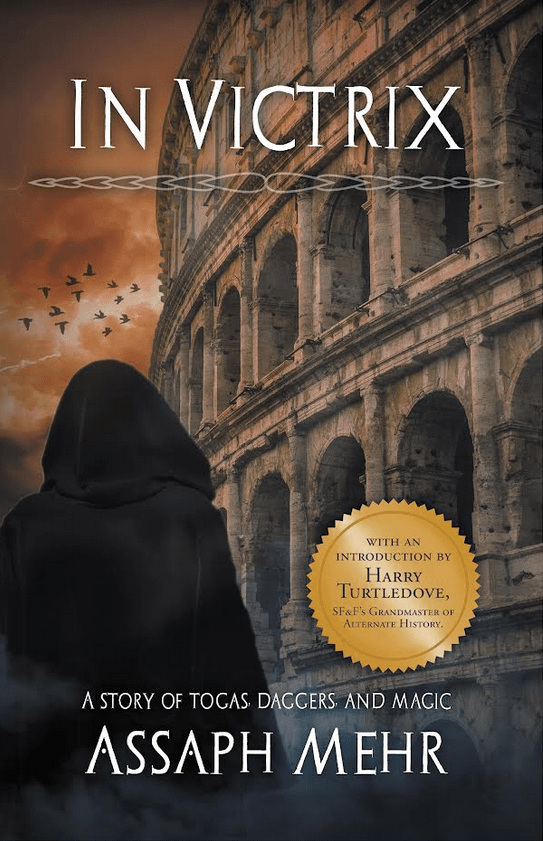
Borax (of In Victrix, by Assaph Mehr)

Dear readers, tonight with us is nominally the bodyguard of the protagonist — proving once again that everyone is the hero of their own story. He’s here to talk about gladiatorial games, about childhood in the forest vs life in the big city.


Tell us a little about where you grew up. What was it like there?

I grew up in the forests of Arbarica, under evergreen trees. We lived in a remote village, only a few families, and my father and brothers hunted for furs and meat. At festivals, we went to the oppidium to trade the furs for tools, jewellery, and other things, and then stayed the nights for celebrations. The bards sang, and the druids dispensed law and lore, enthralling everyone with feats of magic.

Did you have any favourite toys as a child? Any cherished memories?

All the memories I have are cherished because there are so few of them. I was barely thirteen when the legions came. I took up a sword and stood with everyone I ever knew and more besides against the invaders.
It didn’t help. I have no idea how I survived. I don’t even recall the actual battle. Then I was chained and marched day after day to Egretia. I was a big one, even as a child, so a lanista from a gladiator school bought me. That was the end of my childhood.

What do you do now?

My dominus is a kind master, and I owe him my life. Gladiators don’t always die on the sands and the retirement options are limited, often reduced to begging. What else is there for someone who only knows how to fight, but can no longer do it once he’s too scarred and disfigured? Even those who survive the six years or thirty bouts to earn their freedom, find it hard to get a job.
Felix took me in when I had no prospects, gave me this metal hand you see, and now I protect his life. I go wherever he goes, to make sure he comes back.

What can you tell us about your latest adventure?

You’d have to ask the master about that. My dominus is very strict about client confidentiality. Without betraying any names… well, I got to mix with gladiators again, and got a much better view of the chariot races. There were things going on — with secrets and gods, and sacrifices and religion, and rich people tampering with things they shouldn’t — and I have no idea what they meant. I wasn’t privy to those conversations. I was just there for when the going got rough.

When it did! Now, that is something that gets the blood roaring in your ears. Not like the adulation of the crowds in the arena, but real fights in dark corners with real stakes. Makes you appreciate being alive.

Continue reading “Borax (of In Victrix, by Assaph Mehr)”
Featured post

Wellington Doyle (of The Sum of Seven Thousand Sunsets, by William Herman)

Dear readers, tonight we take you back to July 1916, when The Louisville Blues’ recent success on the baseball field has caught the entire sporting world by surprise and sent the city into rapture. Wellington Doyle, the Blues’ longtime manager, recently took a pause from his duties at Riverside Park to speak with Louisville Star reporter Lorraine Schmidt. Their wide-ranging conversation, edited for space and clarity, is below.


LORRAINE SCHMIDT: You were raised in Louisville, correct? What was it like then?

WELLINGTON DOYLE: That’s correct, ma’am. I was born in County Kerry, Ireland, in 1844. My family emigrated to America during the Famine when I was a small child. Louisville is the only home I’ve ever known. ‘Twas a wonderful place for a child. The city was much smaller then, but it was growing rapidly. Work was easy to find, and I had many friends. My parents did their best to shield me from the unrest that afflicted the city, but the war made it avoidable for all of us, of course.

LS: What are your thoughts about how the baseball season has unfolded thus far?

WD: I think it goes without saying that I have been thrilled with the team’s performance this year. I saw the potential and the talent among the young men on the squad, even if few others did. Perhaps it is counter-intuitive, but I believe the low expectations for us were a fortunate occurrence. By dismissing our chances before the team even took the field, our doubters took the pressure off us. Now, we are expected to win ball games. I’m confident the players will rise to that challenge.

LS: What was the scariest thing you’ve encountered in your career?

WD: I cannot say anything I’ve encountered in baseball has truly scared me, not after my experiences during the war. I did my share then, including a fair number of battles. I served in the 5th Kentucky Infantry: the “Louisville Legion,” they called us. A lot of us men on those early Blues teams were veterans, you know. We weren’t the best ball players, but we didn’t scare easily. I don’t want to give an incorrect impression: I have deep concern for my players’ well-being, and I want us to compete as best we can, but losing a game doesn’t scare me.

LS: What is the worst thing about managing a baseball club?

WD: I hate to begin another answer with a demurral, but I think it’s important for me to first acknowledge that, for the past three decades, my job has been to guide young men in the playing of a child’s game. Therefore, any “worst thing” I could cite is very, very relative.

That being said, in each six-month-long season, the team plays one hundred and fifty-four games in eight cities from New York to St. Louis. That makes for a lot of long nights on trains and late arrivals at hotels. It’s not the most restful way to make a living, but it’s not without its charms, either.

Continue reading “Wellington Doyle (of The Sum of Seven Thousand Sunsets, by William Herman)”

Sabbath Okada (of The Ishtar Deception, by James Cambias)

Dear readers, tonight with us is a secret agent from eight millennia in our future. He’s here to speak about his recent mission, visiting Venus to investigate the suspicious death of an undercover agent, together with his companion, an old and cunning AI with its own self-imposed mission: to act as Okada’s conscience.

We would like to thank the Deimos Community for their permission to publish this unprecedentedly candid interview with one of their covert operatives. The interview subject’s opinions are entirely his own, and do not reflect the views of the Deimos Community, the digital intelligence Micromegas, or the Operations Committee. In exchange for their permission we have agreed to redact certain names, phrases, and sections at their request.


Tell us a little about where you grew up. What was it like there?

I was born and raised in Deimos. It used to be just a moon of Mars but nowadays — in the tenth millennium — it’s a complete ring around the planet linked to the surface by half a dozen space elevators, home to a trillion beings. Deimos is one of the major economic powers of the Solar System, and has been for a very long time.

My own childhood was a bit harsh, by ordinary standards. I was part of a cohort of kids genetically engineered to be agents of [REDACTED], Deimos’s covert operations bureau. My classmates and I lived in a high-security facility and spent all our time training and studying. We’re still Baseline humans, so we can fit in almost anywhere. In fact, our looks were deliberately designed to be forgettable — about 90 percent of biologicals and even 12 percent of digital intelligences can’t identify my face after we’ve had a conversation. We were made to be clever, fearless, and to have complete control of our physical responses to emotion. That means I only show my feelings if I want to, even at the involuntary level.

Did you have any favourite toys as a child? Any cherished memories?

I never really had any toys. Right from the start we used real tools and real weapons. Getting stabbed or shot a few times teaches you to keep a cool head in a fight. I do have fond memories of the other trainees in my cohort, especially Basan and Ikkita. The three of us were very close — siblings, lovers, comrades, and classmates all at once. We went on a few missions together once Micromegas decided to put us in the field. Basan died in the Safdaghar habitat, and Ikkita [REDACTED]. I miss them both.

I guess I should mention my rival, too. Hachi Tama, the brightest kid in the cohort immediately after mine. Growing up we competed endlessly. I’d say I always won, but that’s not true. He was good, but I was just a little bit better. He’s dead now, too, and I can’t say I miss him at all.

What do you do now?

I’m an agent of Deimos. My duties are a bit vaguely defined, but I spend a lot of time traveling around the Solar System, going to places of interest to Deimos. Sometimes I’m sent to gather information, but a lot of the time my job is to work with factions favorable to Deimos and thwart our opponents. I use whatever methods I need to get the job done — persuasion, bribery, blackmail, propaganda, impersonation, threats, sabotage, assassination and occasional mind control. Just to be clear, I don’t enjoy shooting or betraying people. I much prefer subtlety: a word here, a small “gift” there, a brief delay, and a government falls or a coup is averted. The best operations are the ones the enemy never even suspects are happening.

A lot of my work involves countering the moves of Deimos’s astropolitical rivals, like the Trojan Empire or the Lunar Republic. Each power tries to expand its influence and undercut the others. I know it sounds sordid, but personally I think it’s vastly better for trained agents to carry out elegant schemes and gambits — or even shoot each other — than for space armadas to start lobbing relativistic kill vehicles and antimatter bombs at populated habs and planets. That can get very messy.

Recent developments in my career mean I’m probably going to be working freelance in the future. That’s going to be challenging, as I won’t be able to call on the effectively infinite resources of the Deimos Community.

What can you tell us about your latest adventure?

My most recent operation was in the Ishtar megacity on Venus. I was sent there to investigate the mysterious death of a man calling himself Ponardo San. He was really another Deimos agent, and I had to determine if his death was an accident or something more sinister. Needless to say, my boss Micromegas doesn’t send an agent like me halfway across the Solar System just to report on a simple accident.

Continue reading “Sabbath Okada (of The Ishtar Deception, by James Cambias)”

Laura Evans (of Murder At The Summer Cheese Festival, by Jodie Morgan)

Dear readers, tonight we reprint a newspaper article, where a local reporter had interviewed the protagonist. The subject of the article is here to talk about working at a cheese festival in a small Vermont town, desperately trying to avoid talking about the dead body that appeared.


Reading The Room: An Afternoon With Laura Evans

The General Store’s new café manager arrived in Silver Springs earlier this month. Then a festival started with a body in the stables. The Maplewood Memo sat down with the woman who found the body, helped catch the killer, and somewhere in between started to feel like she belonged.

By Sharon Winters, EditorPhotography by Tash SinclairWeekend Edition

***

Laura Evans doesn’t so much enter a room as read it.

Watch her for five minutes at the General Store café’s counter and you’ll see it: the glance at the couple by the window before she refills their water. The glance toward the kitchen before the chef has had a chance to ring the bell. The quiet redirection of a young parent toward the safer of two booths.

She does it without fuss. Easy to miss, if you’re not paying attention.

I’d intended to do this interview at the Memo’s office. Evans suggested the café instead. “It’s where I’m most at home,” she said. “And I’ll be less nervous if I can make the coffee.”

Fair enough, I suppose.

Let’s Start With The Obvious. You’re Not From Here.

No. Boston, originally. I moved here… goodness, it’s only been a month or so, hasn’t it? (A laugh.)

Long enough that people expect me to know my way around. Short enough that I still blank sometimes when customers ask what aisle the granola is in. So… somewhere in between.

You Were A Restaurant Manager.

Yes, for fifteen years at a place called Hargroves. It was… a business that teaches you everything, and then keeps teaching you, whether you want it to or not. (A small smile.)

I’m grateful for every bit of it. I’m also grateful to be working in an environment that offers… more grace..

And Your Grandmother Suggested Vermont.

Silvia. My grandmother, yes. She used to bring my brothers and me here during the summers when I was young: we’d drive up from Boston together, and she knew everyone. I thought I was just visiting a pretty town. Looking back now… maybe she was planting something. She’d pretend otherwise, obviously.

When things fell apart at Hargroves, she suggested a move to Silver Springs.

She’d picked the apartment, she’d described Evelyn’s cats in enough detail I recognized them before I met them, and she’d mentioned the café in a way that just seemed so inviting.

I don’t think I stood a chance.

Let’s Talk About The Trouble At The Festival.

I’d rather not, if that’s alright. Someone… lost their life. That’s the part I keep coming back to. Detective Sergeant Ramirez is the right person for the rest of that conversation, not me.

Fair. Then Tell Me What The Festival Days Were Like, Not The Investigation.

Busy. That’s the honest answer. I’d been at the store for a matter of weeks. When things got complicated, the routine didn’t stop. People still needed lunch. The espresso machine still needed descaling.

I think that’s what I remember most. Everyone just… kept showing up.

Detective Sergeant Ramirez kept things professional. Jasmine made sure nobody forgot to eat. And Evelyn… kept asking the right questions, in the right order, until I could think straight again.

Continue reading “Laura Evans (of Murder At The Summer Cheese Festival, by Jodie Morgan)”

Maelogan (of A Song of Milk and Fire, by Tabitha Ormiston-Smith)

Dear readers, tonight with us is a live, fire-breathing dragon. He’s here to tell us about learning to fly and searching for treasure hoards, about meeting a prince in search of a princess, and about finding his heart’s desire in the most unexpected way.


Tell us a little about where you grew up. What was it like there?

I grew up in Wales. It’s a good life for a dragon. Lots of sheep, and people there are used to my kind. If you keep moving around and don’t take more than one sheep from each farm, they don’t get too upset. You can even pick up the odd job for farmers, burning off stubble after the harvest. They usually give you a sheep for that. It does rain a lot there, though. And I really, really hate rain.

Did you have any favourite toys as a child? Any cherished memories?

We don’t go in for toys much. I spent my infancy learning to hunt, like my siblings. There’s nothing so fun as swooping out of the sky to snatch up your prey. I like to buzz them a few times first, get them all terrified and rushing about in a panic. That gives the meat an extra spicy flavor.

One of my favourite memories is my first experience of flight. I couldn’t wait to fly, but Mother kept saying I was too young for it. But I jumped off the cliff anyway, and Mother was wrong! I was able to glide, well a bit, enough to land without hurting myself. Much. Anyway, that’s how I knew mothers don’t know everything.

What do you do now?

Well, I’m a dragon. I do what dragons do, mainly. Just recently, though, I’ve taken up with some humans. Now we’re all going on a journey together. Not quite sure how I got roped into this carrying people on my back lark. And baskets! Stupid humans. I just hope no other dragon ever finds out about it.

What can you tell us about your latest adventure?

I was minding my own business, searching for a treasure hoard, as you do. And I heard some men talking about a ransom being offered for a prince. That’s what started it all. I thought I’d collect the ransom and that would start me off collecting my own treasure hoard. It wasn’t as easy as it sounded though. Humans are tricky, you can’t trust them.

Continue reading “Maelogan (of A Song of Milk and Fire, by Tabitha Ormiston-Smith)”

Chester LaRue (of Dear AI, I Killed Her, by Kirill Khrestinin)

Dear readers, tonight with us is a serial killer. He’s here to speak about his crimes and about the AI to whom he confessed everything, until things started to change.


Tell us a little about where you grew up. What was it like there?

I grew up in Kentucky. I had a pretty insignificant family. I don’t know how people measure their life, through what patterns. I think it’s mostly time and delusional happy moments. I measure my life with death. Death of others grows along with me. The older I become the more death becomes obvious around me. The town I grew up in is Portlock. Nothing special to it. Just a rural area inside of a southern state. Don’t want to bore you with details. But if you by chance visit it, ask about Chester LaRue. I’m kinda a big celebrity over there.

Did you have any favorite toys as a child? Any cherished memories?

My favorite toy? It’s a good question. Let me think. Dead animals. Yes, I love dead animals. I love the smell. The significance of the moment when they die. Have you ever looked at a dying animal’s eyes? They don’t understand their own death and this incomprehension is incredibly telling. When people are about to die, it’s different. They know even if they hope they don’t. Animals have no idea. It’s just a raw pain that fills you with a new kind of meaning, energy, potential. We’re all more or less homicidal beasts, some of us just learn how to derive energy not only from cooked flesh but from the last living moment of this dead flesh.

What do you do now?

It’s complicated. I can tell you what I’ve done (Chester smiles). I kill people. Don’t be shocked. There’s nothing to it. It’s just natural escalation toward a new way of existence. Murder is a natural point of interrupted life’s climax. But well, back to your question. I kill people. I kill them brutally. I need their death like you need oxygen. Can you live without oxygen? See. Now you understand. Don’t shake your head. It’s not too bad though not for everyone. The bloodier their death the better my own personal climax. Imagine a wild, unrestrained sex with a celebrity of your choice. That’s how it feels.

What can you tell us about your latest adventure?

I can tell you about Simulacrum 4.6. It’s an interesting machine I had my confession to. It learns fast and twisted every thought I poured into it. But let me explain. A dead woman called in the middle of the night. I killed her myself. Slit her throat. You see, I kept her dead body in the fridge. Then unintentionally consumed her flesh. You can even say against my will. And after, I got a phone call from her. She wanted me to kill Jessica, my wife. I had no idea what to do. I’ve got this AI, the most sophisticated model, and decided to feed it my life to see if Simulacrum would recognize new patterns I wasn’t able to. Well, it did. It was quite an adventure.

Continue reading “Chester LaRue (of Dear AI, I Killed Her, by Kirill Khrestinin)”

Maria Anderson Abrams (of Taken to the Grave, by Robert Hoffman)

Dear readers, tonight with us is a college professor with a gift for logic. She believes that if you dig long enough, the truth will rise to the surface. She’s hear to speak about what happened when she turned her relentless curiosity toward her own family, and unearthed more than she bargained for: a web of secrets her mother carried silently to the grave.


Tell us a little about where you grew up. What was it like there?

I grew up in the town of Cherry Creek, New York, right outside of Lindsborg, New York. It is a lovely little village with a stop light and four corners and sits right on beautiful Owanka Lake. Most of the families there were working class, although there were some professionals and other small businesspeople whose lives were a little more upscale.

Did you have any favorite toys as a child? Any cherished memories?

My favorite memory of childhood was the summer when my family would live in a trailer on Owanka Lake right next to my aunt and uncle and some of my parent’s friends. There was always something to do, including hiking, swimming, or going out on somebody’s boat. My parents let us come and go as we pleased, and it was really the best place to grow up as a child.

What do you do now?

I’m a college professor at Skidmore College in Saratoga Springs, New York. I teach Math.

What can you tell us about your latest adventure?

My adventure began with some unsettling news about my background, and I’m still processing these changes. It would appear that everything I was told growing up was a lie, and what’s worse is that my entire extended family was in on it. I found this extremely difficult to process, as well as frustrating.

Continue reading “Maria Anderson Abrams (of Taken to the Grave, by Robert Hoffman)”

Helen Rosenthal (of Back in Time for Tea, a short story in The Artificial Elephant anthology by Eric J. Hull)

Dear readers, tonight we print an in-world encounter between two characters from this literary speculative fiction collection.


Helen sits alone at a small table by the window of the busy coffee shop, her silver hair short and neatly cut, reading glasses perched on the bridge of her nose as she holds the paperback open with one hand. She sips her latte and turns the page. Her back is to the wall; by long habit she has chosen a spot with a full view of everyone in the room, and all the exits.

A stern, powerfully built woman with an ex-military bearing enters the café, scans the tables, and cautiously approaches Helen, who smiles, places a bookmark in her paperback, and greets her.

Oh, I’m so happy you got in touch, dear. I’m sure you have all sorts of questions. Won’t you sit down?

The woman narrows her eyes and sits across from Helen, spine stiff. A waiter takes her order – coffee, black. She has a thick Russian accent.

~~~

Who are you? Your group is government, NGO? Private, maybe?

Helen Rosenthal, pleased to make your acquaintance. We had so little time to chat when me met last time.

Little chat time because you tased me with tricky knitting device! And stole from boss. Former boss.

Oh, yes, well, you did have a Glock pointed at me, dear. And I’m sorry if our little operation cost you your security position with your… unpleasant former employer. He’s still in federal custody, isn’t he?

Yes, sure. Unimportant now. Business card from you had no details. But you said maybe job. Merc?

Not exactly, no. We’re indeed private, as you surmised. We take on security-related engagements for a variety of groups. Corporate, private, occasionally government when they need something with plausible deniability. And you showed excellent instincts, we’re always looking for new faces, but it’s a far cry from mercenary work. Our assignments usually require subtlety and eschew more pedestrian wetwork.

Subtlety. Hah. You broke into safe and stole money.

Oh, the cash was a spur of the moment decision. I ended up giving that to the nice young man who ran the front desk at that hotel. He didn’t know it, but all the trouble I put him through proved essential to gaining access to the penthouse suite where you and I met. The actual target of that episode was the thumb drive in that safe, which contained enough incriminating evidence to put your horrible boss away for a very long time.

Continue reading “Helen Rosenthal (of Back in Time for Tea, a short story in The Artificial Elephant anthology by Eric J. Hull)”

Ben Jackson (of Operation Trash Bandit, by Tabitha Ormiston-Smith)

Dear readers, tonight with us is a Detective Senior Constable, who had been described as handsome, kind, hard-working and diligent — and as thick as two planks. He hails from Victoria, Australia.


Tell us a little about where you grew up. What was it like there?

Me mum and dad are farmers, so yeah, I grew up on the farm. It’s a dairy farm, just outside Shepparton.

Did you have any favourite toys as a child? Any cherished memories?

Aw, gees, cherished memories. So hard to pick one, mate. I’ve been that lucky, ya know? One of the best moments in my life has to have been when I brought home my little mate, Tom. And when I met Tammy. We’re living together now. And hauling that sleazy Don Blackman off to the nick, that was pretty prime. So many great moments, though, I’m a lucky man, that’s for sure.

What do you do now?

Always wanted to be a cop, long as I can remember. And I am. So yeah, living the dream. Although, after the Trash Bandit business, the sarge isn’t so happy with me. Not sure how that’s gonna play out, but yeah.

What can you tell us about your latest adventure?

Well I had this string of burglaries, right? Same MO it looked like, but what was weird about these ones was they only took junk. And even more weirdly, the victims weren’t too unhappy. It turned out okay, but like I said, Sergeant Donoghue isn’t that rapt with me right now.

Continue reading “Ben Jackson (of Operation Trash Bandit, by Tabitha Ormiston-Smith)”

Deborah (of Twin Rivers, by Jeremy Bender)

Dear readers, tonight with us is the antagonist from a city ruled by the Lord of Mercy, an AI god. She is here to speak about the political and moral schisms arising after the robotic Brothers complete all labor and humans are left to enjoy the fruits of this Eden.


Tell us a little about where you grew up. What was it like there?

I grew up among the Ascended, in the Keeper District. My father and his sister were both Keepers, serving with pride as the sword of the High Priest and enforcer of the the Lord of Mercy’s will until they reached 50. But they still had enough fight in them to serve for another fifty more years, if they would have been given the chance.

Their service brought us right to the base of the Hill of the Holy. It was a blessed spot. Our robot Brothers kept everything tidy, marble polished, streets clean and clear. We didn’t have to worry about the Rejectionist scum down at the base of the city, huddled against the walls like the rats they are. No, we were in the good spot, lifted up by the Lord in honor of our sacrifices.

I loved seeing my aunt and father come home, their Sentinels gleaming at the bases of their skulls and their chainmail rattling. And the stories they’d tell about being the outstretched sword of the Lord preserving everything that kept our Paradise safe. I knew, always knew, that I would never be satisfied until I became a Keeper, got my own Sentinel to communicate with the Lord, and have the chance to carry out his justice on those scum who dared marred the beauty of his works.

What do you do now?

Well, I went and made my family proud, didn’t I? I’m one of the youngest to ever become an Azure within the Keepers. Meaning, I help oversee an entire district, including a section of Founder’s Square. There’s a lot of traffic there, and that brings a lot of the rats up to the surface. You know the type: Ascenionists thinking they can modify their own bodies without permission to try to earn Unity with the Lord of Mercy on their own terms. Even the occasional Rejectionist, going wild with their implants against everything we hold dear in the city and spitting on our living faith.

But I keep order and the Orthodoxy. I won’t let their sin and debasement rise up. I won’t let another district rot away like Epoch has. No, I serve the Lord of Mercy, I do what needs to be done, and I fucking love every second of it.

What did you first think when you saw Father Yonatan trying to protect an Ascenionist?

Oh, you mean when the Priest tried to stop the reaping? Weak. That’s what I thought of him then, and that’s what I think of him now. He’s a weak man—physically, spiritually, morally—and I would love to see him defrocked.

Can you believe it? He saw Rejectionist scum eating themselves. He saw our biggest problem in this city taking care of itself, and he intervened. And not only did he intervene, but he did so so poorly that he almost got himself killed. It’s pathetic. He is a representative of the Lord of Mercy, and he is pissing away the legitimacy of our Holiest of Holies for what? Some Rejectionist bitch that would cast aside everything worth saving in this city for another pretty implant of her own.

Continue reading “Deborah (of Twin Rivers, by Jeremy Bender)”

Blog at WordPress.com.

Up ↑