Search

The Protagonist Speaks

Interviews with the characters of your favourite books

Tag

Science Fiction

Celeste Bradford (out of The Bureau of Society Betterment, a short story in It Takes A Village Anthology, by Anaïs Chartschenko)

Dear readers, tonight with us is the protagonist from a Utopian world, where everyone lives on massively tall monolithic buildings, and social status is determined by literally how high up you live. She is here to tell us about her world, about moving between levels, and encountering an agent that governs the building.


Tell us a little about where you grew up. What was it like there?

I was born and raised in a monolith. It has a tall center with multiple branches of pods extending from that. Escalators at either end run the entire length of the core. They have stops at each level, with latrines placed conveniently close to the exits so that you don’t have an accident when traveling long distances.

I was not quite lowlith, but not far off, which meant the first pod I remember was slightly below the mid levels. There aren’t as many windows there, but there are a few. I spent quite a few nights sneaking out for a moment at a window. The sky at dawn is particularly beautiful, as it splashes colour against the pale grey walls of the halls.

The left side of the mid pods were mainly used for agriculture. The right is for processing them. I can still remember the smell of compost, which reminds me of why I work as hard as I do. The children’s ward was directly below one of the lower levels of the mids, and while I’ve been told smells rise, this one definitely rose and fell like some sort of decaying cloud.

Did you have any favourite toys as a child? Any cherished memories?

I have an abacus from the children’s ward. I wasn’t supposed to take it, probably, but I don’t think it was missed. The other children were more interested in baby dolls or ball and sticks.

I wanted a grown up doll that looked like one of my first carer’s Ms. Renton. She was so incredibly beautiful I used to imagine she was an Elite.  I was informed by the Matrons dolls with breasts were out of the question. Apparently they needed to protect my morals. Strange, since half the monolith has them.

I’m getting off track. The abacus. It was brought by my second carer, Mr. Dirby. He taught me to count, which was a joy to me. Everything could be ordered, and that calmed me down like nothing else could. I looked forward to Mr. Dirby’s hours.

Of course, he had one look at Ms. Renton and ruined everything. They both transferred out of the children’s ward. Heard they are together to this day, with their brood of non-orphans to watch over. The bright side is he forgot his abacus. When I aged out, I smuggled it under my coat. I keep it on my desk.

On to your next question… Well,  I’m an orphan raised in a sea of wanted children. Few cherished memories. Let me think. I liked the pudding I had once at one of the other kid’s birthday party! I don’t know what the flavor was exactly, but it was the first time I’d had anything that sweet.

What do you do now?

In my current job, I run numbers. Funny how that worked out! I try to keep things running smoothly. Always learning more about people around me. Information is power, another motto. But I’ve done it all! Laundry, peeling vegetation, turning compost, assembling gadgets and do dads, minder of children, secretary, dispatcher, seamstress… There’s more, but I can see your eyes glaze over at the monotony of the list. Believe me, mine did too.

What can you tell us about your latest adventure?

Know what I just said about eyes glazing over? It was noticed.

I was about to move to a higher lith level. I was literally in the middle of a tour with a real estate agent when I found out my account had been tampered with. The apartment was denied even though I had the CAVES! You can imagine how that felt… no. Perhaps you can’t. There is no graceful way to say I lost it.

I only go to the Bureau of Society Betterment under duress. Endless forms and the fear of reassignment if they decide it suits. Did I mention the whole place drives you mad because there is absolutely nothing besides bureaucracy to look at?

Continue reading “Celeste Bradford (out of The Bureau of Society Betterment, a short story in It Takes A Village Anthology, by Anaïs Chartschenko)”
Gabriel Martiniere (of The Martiniere Legacy, by Joyce Reynolds-Ward)

Dear readers, tonight with us is a man from the near future, talking about biotechnology and the multiverse.


Tell us a little about where you grew up. What was it like there?

Before my family died in a plane crash when I was twelve, I lived in Malibu, on the beach. We also spent a lot of time in Paris, France, at one of the major Family holdings, the Hôtel Martiniere, in the 1st arrondissement. When I was ten, I was sent to Northview Military Academy in Utah, and spent school years there. After my family died, I still spent part of my time away from school in Los Angeles, only in the house of the man I thought was my uncle but was really my biofather, Philip Martiniere. Philip’s house was in Beverly Hills and a very different setting from my family’s house. Otherwise, I was in Paris with my uncle Gerard, learning more about the Martiniere Group’s financial operations.

As a child I spent a lot of time outdoors. My parents would take my sister, my cousins, and I out to Anacapa Island where we would spend the day swimming and snorkeling. I played on the beach. When I was very young, I wanted to become a cliff diver.

In Paris, I prowled the city with my cousins. Doing what kids do, but we also spent a lot of time visiting museums and attending cultural activities.

Did you have any favourite toys as a child? Any cherished memories?

Growing up Martiniere had a lot of expectations, especially since I was born into the ranks of the high-level heirs and was being nurtured and cultivated for a leadership role in the family-held conglomerate, the Martiniere Group. I didn’t have any one favorite toy because I spent a lot of time playing with my cousins, whether in Paris or Los Angeles. And memories…ah, best not to go there. My teen years were nightmarish. One of my biggest regrets was that I was horrible to my little sister Louisa and my mother Angelica the last time I saw them alive.

I did have a collection of Marvel action figures and assorted drone and robot models. Who was my favorite Marvel character? Tony Stark, of course. In many ways, I’ve been emulating him, only through development of agricultural technology.

What do you do now?

I am currently the leader of the Martiniere Family and the Martiniere Group, known as The Martiniere. Essentially, that makes me the CEO of the Martiniere Group and, well…there are private Family structures where I serve in much the same role as I do within the Group. When I can, I work on agricultural nanobiobots with my beloved Ruby. My focus is more on microbial payloads, but Ruby and I do a lot of research together on Ruby’s Double R Ranch in Northeastern Oregon.

What can you tell us about your latest adventure?

I’ve discovered that my choices as an adult have gone very differently in other universes—in one universe, my family did not die in a plane crash when I was twelve and I learned that Philip was my father when I was sixteen. In every other universe I know about, that didn’t happen. However, I am engaged in a war against digital thought clones in nearly every universe, along with my brilliant, bold, beautiful wife Ruby. Most points of divergence happen as a result of when I tell Ruby who I really am, except for that one universe I mentioned.

Continue reading “Gabriel Martiniere (of The Martiniere Legacy, by Joyce Reynolds-Ward)”

Katrina (Cat) Mancini (of Life and Death on Mars, by Edward M. Lerner)

Dear readers, tonight with us is an astronaut, speaking about the second cold war in the near future and the race to Mars between the US, China, and assorted billionaires.


Tell us a little about where you grew up. What was it like there?

I was an Army brat, so you name it. A half dozen places in the US. All across Europe. Once Japan and twice Australia. I can mispronounce words and mangle syntax in five languages. Apparently I speak French and German like an Alsatian, which is an insult from both sides. Ask me if I care.

Anyway, the first few moves taught me not to get too attached to places – or to people. Don’t take that to mean I’m some kind of loner, because I also learned to make friends quickly. Having friends around the world? That’s seriously cool.

As odd as the lifestyle seems to most folks, it’s what I knew. Straight out of high school, I enlisted. Already then I’d had my eye on going to space, and any of the services would pay for an engineering degree. Becoming a pilot was the logical first step and the Air Force, by far, has the most pilots of all the service branches. You don’t want to know how Dad took it when I joined the Air Force. He coped better with the move to NASA.

What do you do now?

Commander of NASA’s international Ares mission to Mars. Pilot of Meriwether Lewis, one of the mission’s pair of spacecraft. The second ship, of course, is the William Clark.

Anyway, that’s what I did until … well, best I not say.

What can you tell us about your latest adventure?

Only insane people would think to throw together a crewed mission to Mars in less than two years. Those, unfortunately, are the people I work for. After President Wu announced a mission to Mars, no way was our president willing to let China get there first.

Speaking of lunatics, well, then there’s my unofficial overseer. More than anyone, Xander Hopkins was the architect of our mad dash. It serves Xander right that the prez plunked him into my crew to be her eyes and ears. Even if – eventually – he became a good friend.

What did you first think when you got to Mars?

Technically speaking, I didn’t. I got us safely to its moon Phobos. From Phobos, we dispatched an armada of robots to explore the world below. Because to actually set boot on Mars would have massively compounded the challenges – challenges which the other guys discovered all too soon.

At way less than one light-second’s round-trip comm lag with the surface we had real-time control of all those bots. We could, and did, cover lots of ground. Drilled lots of exploratory holes. Flew everything interesting up to our Phobos base for closer examination.

You know what? Forget the party line that from Phobos we were responsibly searching for Martian life. That we posed no risk of contaminating it – if it was even there – with earthly microbes. I wish to God we could’ve flown those last few thousand miles. Instead, we had Mars ever overhead. Like a mottled red dinner plate hanging in the sky. Looming. Taunting.

What was the scariest thing in your adventures?

Setting aside That Which Cannot be Revealed Without Spoilers, there’s still much to choose from. I’ll go with the landing on Phobos because landing is such misnomer. Phobos is basically a potato-shaped rock. Its longest axis is scarcely 16 miles. A rock that small has no gravity to speak of. You don’t actually land there. You very carefully dock with it – only there’s no docking mechanism to engage.

What you do is, you harpoon the damned potato, then slowly reel yourself to the surface. No one knew for certain till we arrived that’d this could even work. Would harpoons bounce off? Would their impacts spatter us with rocky debris? What if any of our tether reels froze at the last moment? What if tethers tangled? Coming down askew, not squarely on our landing feet, could’ve bashed in something critical and stranded us.

Surrendering control to a damned computer and glorified garden-hose reels is no pilot’s notion of a good idea. Scary as hell, in fact. Not that, in front of crew, I ever said any of that. But, okay, in the end, the landing worked as planned. We did get down in one piece.

What was the worst thing about living on a spaceship?

Had you asked me about any previous mission, I’d have said the crowding. Spaceflight is like a bunch of people living together in a closet. Or maybe I’d have said the smell, for pretty much the same reason. But those previous flights were to Earth orbit, or lunar orbit, or to the Moon itself – in every case, for just a few days.

The flight to Mars took six months! You can’t help but get used to the crowding. It’s that or go psycho. You can’t help but become immune to the stench. Which leaves … the people themselves. You can’t get away from them – or them from you. You can’t not get on one another’s nerves from time to time. Sure, the psychologists had had their say. They’d declared us compatible. As if they had any clue what it’s like.

Aboard Lewis with me were the aforementioned Xander, the mad genius behind our crazy mission plan, and the uptight Canadian flight surgeon, Sonny Ying. We were at times, despite our best efforts, like cats and dogs. Or maybe oil and matches. And utterly dependent on one another.

What is the best thing about it?

As it turns out, Sonny. She and I developed … a thing. Which, I’d hafta guess, became the worst part about the flight for Xander. There’s not a lot of privacy in a closet.

Whom (or what) do you really hate?

Xenophobe paranoid nutcases. They don’t want us to go home! In the name of protecting Earth from some imaginary Martian plague, the so-called Planetary Protection League is already a sort of plague on Earth. Damned Luddites.


Edward M. Lerner worked in high tech and aerospace for thirty years, as everything from engineer to senior vice president, for much of that time writing science fiction as his hobby. He is the author of sixteen SF novels (five of them collaborations with Larry Niven) and dozens of shorter works. His 2015 novel InterstellarNet: Enigma won the inaugural Canopus Award for fiction “honoring excellence in interstellar writing,” while other of his works have been nominated for Locus, Prometheus, and Hugo awards. He also writes popular science, notably including Trope-ing the Light Fantastic: The Science Behind the Fiction.

You can find Cat on the pages of Life and Death on Mars.

Browse our archives for past interviews, or follow the site by email (bottom-right) to know immediately when your new best-book-friend makes an appearance.

Rhona “The Heretic” Hunter (of How I Survived the Cthulhu Apocalypse, by Richard Weber)

Dear readers, tonight with us is a young woman who bore witness to a series of cataclysmic cosmic events. She speaks about facing vicious abominations, droves of those who have become mere husks of their former selves, and a dangerous cult bent on sacrificing our world to The Great Old One.


Tell us a little about where you grew up. What was it like there?

Atlanta. It was like any other big city, full of opportunities and barriers to those opportunities. Leaving there for Lexington, during what we now call the Cthulhu Apocalypse, was bittersweet. It was my home.

Did you have any favourite toys as a child? Any cherished memories?

My telescope. I was an astronomy nerd from the get-go. I learned at an early age (about 10 or 11) how small the Earth was compared to the vastness of the cosmos.

My most vivid memory is spending summer vacations at Lake Allatoona with my parents. I’m an only child but was allowed to explore on my own. One summer, I discovered a hidden door in the cabin we were staying at. It was in the empty bedroom where we stored our luggage. It was a small door under the staircase that ran up to the loft on the other side of the wall. I went inside and discovered a small library of books stacked up in a pile and covered with dust. All were books by H.P. Lovecraft. I took them all and read them the rest of the vacation. I owned them up until the events in 2028 that changed the world forever.

What do you do now?

I kill Lovecraftian monstrosities, and eventually (hopefully), Cthulhu himself. I also am a co-General for The Elder Sign Army – working with Generals Ben “The Nameless One” Walker, Frank “The Lawman” Hodges, Roger “Dirge” Young, and Gail “Star” Simpson – to organize a resistance against The High Priest and his Cosmic Church of the World Eater; fend off the aforementioned monstrosities; and am preparing to take a stand against Cthulhu upon his arrival at Red River Gorge in the coming weeks.

Continue reading “Rhona “The Heretic” Hunter (of How I Survived the Cthulhu Apocalypse, by Richard Weber)”

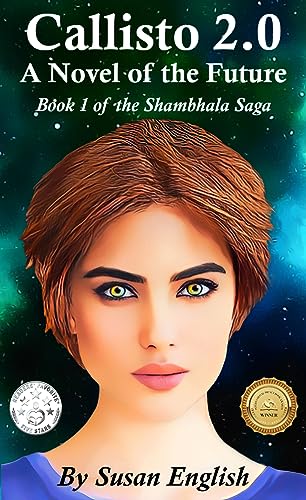
Liu Mei Xing (of Callisto 2.0, by Susan English)

Dear readers, joining us tonight is a filtration specialist from the future. She is here to tell us about life on the Shambhala space station, experimenting with exploding food and creating sustainable space cuisine as she navigates the challenges and wonders of living in microgravity.


Tell us a little about where you grew up. What was it like there?

I was born and raised in Shenzhen, China. I love the city’s mix of tradition and modernity. Living near the coast was fantastic. It was the best of both worlds, a vibrant city life and beautiful nature. I can still remember the smell of fresh produce and local treats at our local market, and the mountains and ocean are incredible.

Of course, Shenzhen has its challenges too, like social inequalities, which made me want to give back and make a difference. But it also has a rich cultural heritage with festivals and dances.

Growing up in such a diverse place made me curious and adaptable. Those traits have stuck with me and guided my journey, but my roots in Shenzhen keep me grounded and motivated.

Did you have any favourite toys as a child?

Oh, for sure! I had a few favorites. One was a Smart Origami Set, a gift from my parents. It combined the ancient art of paper folding with modern technology, and I was able to create these intricate, animated paper sculptures through an interactive app on my tablet. It sparked my creativity and got me hooked on my cultural traditions and technology!

I also had a collection of robotic pets. There was one in particular I absolutely adored. It was a robotic bird named Tian, which means sky in Chinese. I took it everywhere with me! Tian could sing, and we would even perform duets together. So much fun!

What are some of your cherished childhood memories?

I remember weekend family outings to the mountains. We’d get away from the busy city life and simply enjoy the great outdoors. My dad liked to teach me all about different plants and animals, and he made sure I appreciated the natural world. As you know, China, along with the rest of the world, was hit pretty hard by global climate change, and he wanted me to understand its impact, but also to see the real progress scientists are making in restoration efforts.

One of my most special memories was a trip with my grandparents to a local folk festival. I got to participate in a traditional dragon dance and even wore a piece of the dragon’s costume! The whole experience was so exciting and full of energy, with traditional music and vibrant colors, and it made me feel connected to my culture and community.

What do you do now?

My official role on the Shambhala Orbital Laboratory is Filtration Specialist, but my responsibilities have evolved since I first started with the Foundation. I also work with a colleague, Fae, on food production. Recently, we succeeded in creating a brand-new recipe which was a big hit with the crew! It felt like a major accomplishment to have a meal made entirely from food grown on Shambhala. Oh yeah, I sometimes organize karaoke sessions at our Friday night socials!

But working on Shambhala is not just a job for me; it’s a way of life. The philosophy of unconditional love and support that permeates our organization aligns perfectly with my own values. I feel truly grateful and honored to be part of the Foundation.

Continue reading “Liu Mei Xing (of Callisto 2.0, by Susan English)”

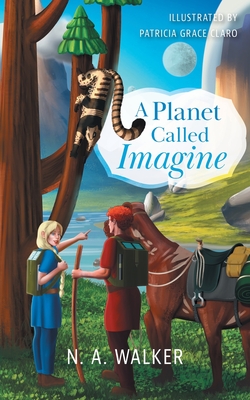
Eiric (of A Planet Called Imagine, by N. A. Walker)

Dear readers, tonight with us is an interplanetary settler, from a group of humans which escaped Earth. He’s here to tell us about exploration expeditions with centuries old technology, with survival of the species hanging in the balance.


Tell us a little about where you grew up. What was it like there?

I was one of the first children born after we landed on the planet we named Imagine! Our ‘Generation Ship’ was taken apart to form our habitat, where I lived my first twenty years. My childhood was pretty happy and uneventful. Went to school every day and learned science. Ate meals in the dining hall with the whole community. Worked out in the recreation center in the evenings.

Did you have any favourite toys as a child? Any cherished memories?

I really liked the building toys we had in school for our “creativity breaks”. We really didn’t have many toys of our own, because we didn’t have much room in our quarters, especially because I had to share a room with my two younger brothers.

Memories – The only thing that stands out was the day my friend Pritz showed up with a baby Beast that he’d met out on the plains. That was pretty cool. When it grew up Pritz taught me how to ride it!

What was your job?

When I graduated from school I was assigned to Maintenance. It was pretty boring. Changing lightbulbs. Fixing broken toilets – pee-uw! I was glad to get away from that.

What are you doing now?

I’m proud to be part of the first expedition into the mountains since the one twenty years ago when my father died. The colony desperately needs resources, especially metals, so we are following the creek up into the mountains to see if we can find where the ore-bearing stones in the creek are coming from.

What did you first think when you found the remains of the helicopter?

The first thing I thought was that maybe we’d find my father’s corpse in it! I was scared to look. But when we got all the creepers off it, there were no remains there. Also, no clue as to what happened to him.

What was the scariest thing in your adventures?

The first night we were camping out, I started wondering if there were any large predators watching us. Pritz assured us that the Beasts would give us some warning if anything dangerous came close. But I kept glancing over my shoulder when we were sitting around the campfire. But so far, so good!

Continue reading “Eiric (of A Planet Called Imagine, by N. A. Walker)”

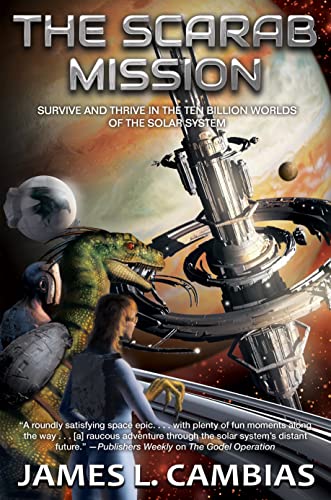
Solana Sina (of The Scarab Mission, by James Cambias)

Dear readers, tonight with us is a interplanetary scavenger, salvaging wrecked and abandoned space habitats. She is here to speak about space pirates and explosive secrets.


Tell us a little about where you grew up. What was it like there?

I was created in a space habitat called Kumu, out in the Kuiper Belt. My early childhood was . . . well, anyone who didn’t grow up in Kumu would think it was bizarre and horrifying. You see, Kumu’s main industry is the creation of Qarinas — genetically-engineered sexual slaves. I thought that life was normal because I never knew anything else, but then a task force of Salibi soldiers invaded Kumu, took off all the Qarina slaves, and destroyed everything else. I spent the next few years in a Salibi habitat, learning how to be a person with free will.

Did you have any favourite toys as a child? Any cherished memories?

I don’t want to talk about the “toys” I was given as a child. My most cherished possession is the set of goggles I was given when I left the Salibi habitat: they filter my vision to thwart the hard-wired programming in my brain, which would otherwise make me willingly obey commands from any other human.

What do you do now?

I’m a scarab — we salvage abandoned space habitats and get them ready for recycling. It can be dangerous, though I didn’t expect anything like what we encountered at Safdaghar.

What can you tell us about your latest adventure?

We went to an abandoned hab called Safdaghar, which nobody had visited for sixteen years after some disaster wiped out everyone there, including the main AI which controlled the place. We planned to loot as much valuable stuff as we could find, before boosting the wreck into a trajectory which would take it out to the Kuiper habitats, where metal is really valuable. My boss Yanai got paid for moving Safdaghar, but all our salvage would be pure profit.

Continue reading “Solana Sina (of The Scarab Mission, by James Cambias)”

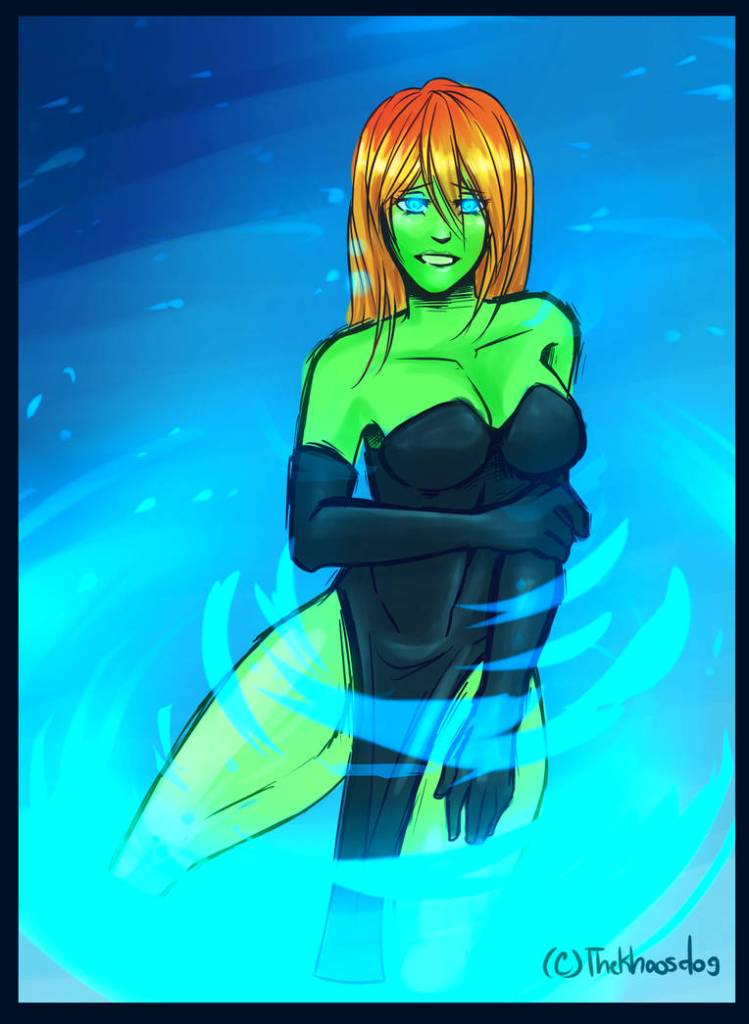
Stacey Roberts (of The Green Girl and The Serum, by Sean Armstrong)

Dear readers, tonight with us is a young woman who was injected with a serum that transformed her into the Green Girl, to be used in warfare by the British Military. She is here to tell us about strife within the Mega Human community, and with society at large.


Tell us a little about where you grew up. What was it like there?

I grew up in inner city Manchester England where I lived with my mother and younger sister and older brother it was quite hard as we weren’t a rich family.

Did you have any favourite toys as a child? Any cherished memories?

As I mentioned earlier I lived with my family my father wasn’t always at home as he worked away from home as he was working on some top secret science project which I learnt about was call the Mega Human program.

What do you do now?

When I was in my late teens I volunteered to become injected with the first strain of the Mega Human serum this transformed me turning my once pale skin green I developed heightened senses and decided to escape from the lab I then moved to Florida USA where I became a model hiding under the name the Green Girl.

What can you tell us about your latest adventure?

In Florida I met my former boyfriend and lover Ben Fox who had also been injected with the serum and formed his own Mega Human group. Together we launched an attack on a military base and defeated both the US army as well as Doctor Sarah Young who had taken credit for my fathers work. Currently we are fighting the outcasts another Mega Human faction lead by Surge a vile and hatefully Mega Human who plans to use the serum to create an army of Mega Humans loyal to him.

How is it like, being a Mega Human?

As Mega Humans we are hated due to how the media and the worlds governments portray us as we were created only for the use of warfare nothing else.

Continue reading “Stacey Roberts (of The Green Girl and The Serum, by Sean Armstrong)”

Sarge (of Underground Planet, by Cindy Tomamichel)

Dear readers, tonight with us is a female mercenary taking on the odd, risky jobs across the galaxy. She is here to tell us about a planet wide labyrinth of mining tunnels, metal processing, acid waste levels, where abandoned cities are thriving with a genetically engineered ecosystem of predators, prey, and mutant humans.


Tell us a little about where you grew up. What was it like there?

Geez, I haven’t thought about that hellhole since I left. I grew up in an orphanage on a slum planet. There’s a lot of bad places to live in the universe, and I was lucky enough to born on one of the worst. Mind you, they are good recruiting grounds for the Academy. I was fast and homicidal as a young girl, and it was my ticket off planet before I ended up in a whorehouse. Woulda made more money there than the military, I reckon. But I’m kinda choosy.

Did you have any favourite toys as a child? Any cherished memories?

The cook at the orphanage – Ella – she taught me to cook and knocked off a few of the rough edges. Most kids there couldn’t read, so I got lucky with Ella. She was a bit tight lipped about her past, but I learned to read from old weapons manuals, so some sort of past she was probably hiding from. She gave me my first weapon  – a knife that I could hide in my sleeve. Saved me more times than I can count.

What do you do now?

I left the Academy to look after Johanna. She needed me, poor little thing. Abandoned on a planet and trying to feed other kids on scraps from bins and avoid the slaver gangs. She’s done me proud – we run a tight ship as a small mercenary team with Daisy and Jasmine and Jock. We’ve made some money and had some fun raiding the military. Can’t ask for more than that.

What can you tell us about your latest adventure?

Well, it was no picnic, that’s for sure. Our last job was for Chagar, a mutant human. He’s a good bloke, even if things on his planet tried to eat me! We helped him look for some old treasure, and lordy, we had the richest man in the universe – McAllister – and his team of thugs on our tails the whole way.

And the planet! A maze of critters that want to eat you, acid levels, shark filled lakes, and don’t get me started on rockfalls. Or mention ladders. Nice people, but seriously, I don’t know how they survive, or how Chagar expected us to survive and protect him. It was a hell of an adventure.

Continue reading “Sarge (of Underground Planet, by Cindy Tomamichel)”

Create a free website or blog at WordPress.com.

Up ↑