
Dear readers, tonight with us is an immortal training in an order dedicated to healing. When a beloved mortal falls deathly ill, she must travel back to her mortal origins in the sixth century to save him.
Tell us a little about where you grew up. What was it like there?
I don’t remember where I grew up. My past is a fog I can’t quite lift. I’ve tried to shape it, to grasp something solid, but the memories dissolve as I reach for them.
Michael found me wandering in Paris. He took me in, became my teacher and guardian. He said we were different. At first, I thought he meant we didn’t belong. Later, I learned he meant we were immortal.
He brought me to his chateau in France and trained me in the immortal arts. He told me we were part of a society called the Group of World Servers, devoted to healing human fear because it blocked their evolution and their capacity to accept us among them. We were not meant to take their pain away, but to minister to it so they could heal themselves.
But to return to your question: if I had a hometown, I don’t know its name. Whether there were trees or towers, winters or summers, all of it is lost to me. What I do know is that I didn’t just lose a home; I lost the story of where I began. That absence has shaped me more than any place could have.
And yet sometimes I dream of a woman with bright eyes and a voice that commands the wind. Her name rises like a forgotten incantation—Cerridwen. I don’t know if she is memory, myth, or the shadow of who I once was. But she walks with me, quiet and ancient, in the blood I carry.
Did you have any favourite toys as a child? Any cherished memories?
If I did, they’re gone. I sometimes believe I’m older than anyone knows—possibly centuries old. If there were toys, they might have been hand-carved, or stitched from scraps. Or maybe there were none at all.
Even if I once held something dear—a doll, a book, a worn blanket—I no longer remember the feel of it. And without memory, joy becomes something abstract. A shadow, shaped more by faith than experience.
The absence of memory is its own grief. A quiet, aching kind.
What do you do now?
I’m a healer. I once travelled with Michael to places torn by war and suffering. But I live in tension with the vows I took.
I have the power to fully heal—to stop death, erase pain, restore a body to wholeness—but I’m forbidden to use it. The rules say we can calm and comfort, but never intervene. Not even when a child lies dying in front of me.
I don’t believe I chose this life. Because if I had, I would have chosen differently. I argue with Michael. I push the limits. I carry guilt like it has been sewn into my skin.
Right now, I’m on a break while Michael travels in Europe. He left me with the Bensons in Coriander, New Hampshire. A mortal family. I’ve been attending high school and pretending to be eighteen forever.
They say our mission is to help humanity evolve on its own terms. But what use is power if you must keep it hidden? What kind of oath demands you let someone die when you could save them?
So what I do now is live in that space between obedience and defiance. I try to honour my role without losing my soul. And in quiet moments, I wonder who I might have been, if choice had been mine.
What can you tell us about your latest adventure?
I wouldn’t call it an adventure. It was a reckoning. A collapse. A return. And maybe a kind of resurrection.
I discovered I’m not just immortal. I’m something more—tied to an ancient prophecy that speaks of a child born to an immortal who might one day bridge the mortal and immortal worlds.
But none of it mattered when Damien fell ill.
Damien is mortal. Fierce and brilliant, stubborn and kind. He loved me for who I was, not for what I might become. When he grew sick, and the light began to leave his eyes, the world shrank to the pain of watching him fade.
Michael told me it was too late. That even my power couldn’t reach him. But I couldn’t accept that.
So he gave me an elixir and said I had to return to the moment I became immortal. Only there would I discover what Emila truly was. He would not explain further.
So I drank. I went back through time, through memory, and became my former self—Cerridwen, High Priestess of the Isle of the Mists.
I didn’t do it because I was chosen. I did it for Damien. Because loving him is the one thing I never doubted. And I would risk everything to save him.
What did you first think when you began to discover the truth?
At first, it felt like stepping into someone else’s life. A stranger’s story written in the margins of mine.
What I thought was amnesia turned out to be something deeper. I hadn’t forgotten—I had been made to forget.
When the memories returned, they did not arrive gently. Some came like shattered glass. Others, like flickers of warmth and joy. I remembered a community I once led, a movement rooted in spirit and dignity. That knowledge gave me strength.
But I also remembered betrayal. The kind that breaks you from the inside. Just as I began to reclaim who I had been, I came face-to-face with what had been stolen from me. A loss so profound I hadn’t known I carried it until it nearly undid me.
Through it all, Damien remained. The more I remembered, the more fiercely I loved him. And with that love came a power I had never touched before.
So what did I think when I discovered the truth? That I had lost everything. And then, that I might still have enough to fight.
What was the scariest thing in your adventures?
There were many frightening moments. Facing Mordecai. Uncovering memories that tore through everything I believed. Confronting a prophecy I never asked to be part of. But none of that compared to the fear of losing Damien.
He had become my centre. My tether. And when his body began to fail, when healing wouldn’t reach him, I was helpless. It wasn’t a lack of power, but a kind of block—as if the universe itself had decided his fate and sealed him away from my touch.
To save him, I had to walk into a past I hadn’t asked to remember. I had to confront betrayal and loss buried so deeply I hadn’t known they were mine. But Damien’s love was the thread that held me together. Even as his strength failed, he made me believe I could endure what was to come.
Without him at the edge of death, I might never have dared to return to my origins. That was the scariest part: knowing I could lose him, and still choosing to face it all.
What is the worst thing about being who you are?
The loneliness. And the silence that comes with it.
Even among those who care for me, I remain apart. I do not age. I’m held to vows I never made, bound to rules I didn’t write. Every time I reach for something real, something human, it slips through my fingers, as if I have no right to it.
To love, to choose, to belong—these are things I am told I must set aside.
What is the best thing about it?
It wasn’t a single moment. It was the long, slow return to myself.
Learning who my parents were and what they had done to protect me awakened something deep within. So did seeing Damien clearly and recognizing what he meant to me across lifetimes.
Michael, always nearby, never let danger claim me. But he also gave me room to grow. To remember. To reclaim.
And then there was Mordecai. For too long, he existed only as a shadow. In Coriander, I finally saw him for who he truly was. The threat no longer vague but real, and faceable.
The best part of my journey was the reclamation itself. Of truth. Of grief. Of strength I had almost forgotten was mine.
Tell us a little about your friends.
I once believed I was alone, until I met Michael. He found me when I was lost and treated me not as a curiosity, but as someone who mattered. He has always been constant, often unyielding, but never absent.
Then there’s Thomas. A fellow immortal, and the only one who can make me laugh even when everything feels heavy. He doesn’t take the Group too seriously, which might be why I trust him. He sees through the roles we are forced to play.
Mr. Benson is mortal. Michael left me with his family two years ago, and since then, they’ve become something like home. Mr. Benson, who I’ve come to call “Dad,” drinks coffee with me most mornings. He doesn’t ask questions. He doesn’t judge. He simply shows up. That kind of presence is rare.
But my truest friend is Cerridwen. She is me, or I am her. We shared a body and a purpose when I returned to my origins to discover Emila. What was extraordinary was that we didn’t struggle for control. We listened. We learned. And through that, we became whole.
Any romantic involvement?
It’s complicated, and yet it isn’t.
There’s Damien, a mortal, whom I met in Coriander while staying with the Bensons. But knowing him felt less like meeting someone new and more like remembering something ancient and essential. As if my soul had always known his. As if we had been circling each other across lifetimes, waiting for the moment when we would finally arrive.
There is a kind of love that doesn’t live in the body alone, but lodges in the very fabric of consciousness. A love that changes how you see the world. That stays with you in silence and in storm. That tightens in your chest when they are near and leaves you unmoored when they are not.
Damien is that for me. He is gravity and fire. He is the quiet I didn’t know I needed, and the chaos I would walk into willingly. My love for him is not a choice I made. It is something that unfolded in me slowly, like light reaching the deepest part of a forest.
There was also Gareth, once, long ago. As Belinda, I resisted him. But even that story holds echoes of something real and something that matters.
What draws me to them both is not just their strength, but their hearts. They live with tenderness. They lead with love. And in a world so fractured, that kind of love is rare. It does not falter. It does not retreat. It endures.
And so, I love. Not because I am allowed to, but because I must. Because some bonds are too old to be severed. Because some souls find their way back, again and again, until the love between them becomes a truth no one can take away.
Whom (or what) do you really hate?
Hate is not something I choose. I’ve seen what it does, how it corrodes. I won’t carry it.
But Mordecai frightens me. Not only for what he has done, but for what he believes—that power excuses cruelty, that control can masquerade as love.
I despise the way he bends hope into something dangerous. The way he takes trust and turns it into obedience. He has harmed people I love, and I will not allow it to happen again.
Stopping him is not about vengeance. It is about freedom.
What’s your favourite drink, colour, and relaxing pastime?
Jasmine tea, steeped from loose leaves in an old mug my mother gave me, back when things were simpler. That, and sitting by the window during a storm. I’ve always trusted skies that don’t pretend to be calm.
My favourite colour is midnight blue. The moment before starlight appears. The colour of truth, just before it is spoken.
And if I could choose my rest, it would be an hour with no demands. No mission. No pain to absorb. Just stillness.
What does the future hold for you?
I used to imagine a normal life. School, work, maybe a quiet place to read. But the future has changed shape. It’s louder now, heavier.
There are still truths I haven’t uncovered. Still promises I must keep. I know this isn’t the end. More will come—more danger, more choices, perhaps more loss.
But there will be hope too. There must be.
Can you share a secret with us, which you’ve never told anyone else?
There’s something inside me I don’t fully understand. A feeling I can’t explain. Sometimes I dream of wings. Of being seen completely. Sometimes I hear my mother’s voice when no one else is near.
I’ve never said this aloud, but I think I was meant for something I haven’t yet become. Something vast and unfinished. And I wonder if my mother always knew.
Deborah Ann Gordon is a novelist who has written four books, including the three books in The Butterfly Prophecy series and her first psychological thriller, The Onion Murder. She has also written poetry and published reports, articles and other works of non-fiction. She was the head of a not-for-profit organization dedicated to advancing health research in Canada for twenty years. Ms. Gordon lives in Ottawa, Canada with her husband, twin daughters and two canines. She spends her time writing, serving on two health research boards and being with her family.
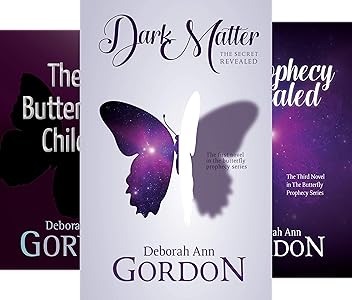
You can find Belinda on the pages of Dark Matter, book one in the The Butterfly Prophecy Series.
Browse our archives for past interviews, or follow the site by email (bottom-right) to know immediately when your new best-book-friend makes an appearance.


 The Protagonist Speaks
Leave a comment